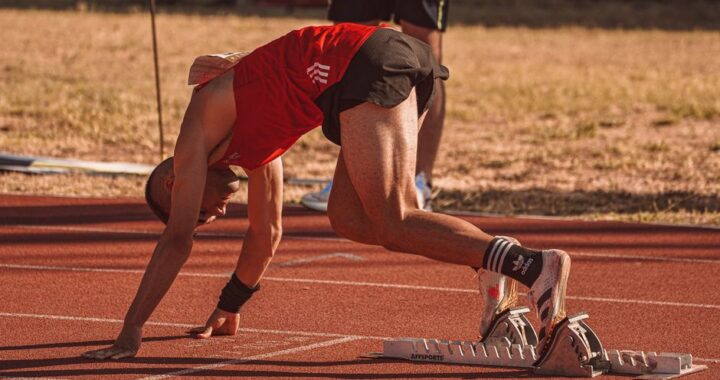

A sprinter can be strong in the weight room and still lose speed on the track if that strength cannot be applied quickly. Plyometrics for sprinters target that missing link: the ability to absorb force, switch from landing to take-off and produce power in very little time.
The best plyometric programme is not the one with the most jumps. It is the one that improves explosive movement without leaving the athlete too fatigued to sprint well. Exercise selection, landing quality, surface, recovery and training age all matter.
Why plyometrics matter for sprint performance
Sprinting involves repeated contacts with the ground. During each contact, the athlete must tolerate force, keep the foot and ankle stable, and push the body forward rapidly. Plyometric exercises train this stretch-shortening cycle—the brief transition between a muscle lengthening under load and contracting powerfully.
This is why sprint jump training can support several qualities at once:
- Reactive strength: the ability to produce force quickly after landing.
- Elastic stiffness: controlled stiffness through the ankle, knee and hip during ground contact.
- Coordination: efficient timing between the arms, trunk and lower body.
- Acceleration power: forceful projection during the first steps of a sprint.
- Maximum-velocity mechanics: quick, upright contacts with less unnecessary collapse.
Plyometrics do not replace sprinting, strength training or technical work. They complement those elements. A broad jump may help an athlete express horizontal power, but it cannot teach the complete rhythm and posture of a 100-metre sprint.
The best plyometric exercises for sprinters
Exercise choice should match the quality being developed. Beginners generally benefit from low-complexity movements with clear landing positions. More experienced athletes can gradually use faster and more demanding drills.
Low-level exercises
- Pogo jumps: Small, quick jumps with a relatively stiff ankle and minimal knee bend. These develop ankle reactivity and landing rhythm.
- Skipping variations: A-skips, straight-leg skips and dribble runs can improve rhythm, posture and elastic coordination.
- Snap-downs: Drop from a tall position into a controlled athletic landing. This teaches force absorption before more demanding jumps are introduced.
- Line hops: Short hops forwards, sideways or over a line. Keep the movement quiet and controlled rather than chasing height.
Moderate and higher-level exercises
- Countermovement jumps: Jump vertically after a quick dip, landing with the knees aligned over the feet.
- Broad jumps: Project the body horizontally and land in a stable position. These are particularly useful for acceleration power.
- Bounds: Cover distance with alternating, powerful contacts. Bounds demand more coordination and should be introduced after basic landing mechanics are reliable.
- Hurdle hops: Move over low obstacles with quick, controlled contacts. Start with low hurdles and stop when landings become noisy or poorly aligned.
- Depth jumps: Step from a raised surface, land and immediately jump. This is an advanced reactive-strength exercise, not a starting point for new athletes.
A sprinter looking for the best plyometric exercises for 100m speed does not need every movement in one session. Two or three well-chosen exercises are usually more useful than a long circuit that reduces jump quality.
How to build a plyometric programme
Use plyometrics early in a training session, after a progressive warm-up and before heavy fatigue develops. The athlete should feel alert enough to jump sharply and land with control.
A simple progression can look like this:
- Learn landing mechanics. Practise quiet landings with the feet under the body, a stable trunk and knees tracking in line with the toes.
- Add low-level elastic work. Use pogos, skips and line hops to develop rhythm without excessive impact.
- Introduce horizontal power. Add broad jumps and controlled bounds to connect jumping ability with acceleration.
- Increase intensity carefully. Use hurdle hops or depth jumps only when the athlete can maintain posture and contact quality.
- Reduce volume as intensity rises. Higher jumps require more recovery, even when the session appears short.
For many developing sprinters, one or two plyometric sessions per week is enough. A session might contain two to four exercises, with two to four sets of a small number of high-quality repetitions. Rest for roughly one to three minutes between demanding sets, and take longer breaks when the movement is highly explosive.
Count ground contacts rather than judging the workout by how tired it feels. If jump height, distance or landing control drops noticeably, the useful work is probably over.
Where plyometrics fit in a weekly sprint plan
Plyometric training should support the hardest sprint sessions rather than compete with them. A common arrangement is to pair jumps with acceleration or maximum-speed work on the same high-intensity day. The following day can then focus on recovery, mobility or low-intensity technical work.
For example, an athlete might perform a warm-up, a small amount of bounding or broad jumping, short sprints with full recovery, and then strength work. The exact order depends on the athlete and the goal, but high-quality sprinting should not be buried beneath a tiring plyometric circuit.
On a grass field, a track or a firm indoor surface, select drills that suit the available space and traction. Very hard concrete, uneven ground and slippery surfaces increase the difficulty of controlling landings. In hot African climates, hydration and session timing also matter: poor heat management can reduce coordination before the jumping begins.
Common mistakes and safety considerations
The most common error is treating plyometrics as conditioning. Continuous jumping until the legs burn may create fatigue, but it does not necessarily improve explosive performance. Sprint plyometrics should be crisp, technically sound and separated by enough recovery.
Other mistakes include using excessive box height, adding depth jumps too early, landing with locked knees, and increasing both jump intensity and weekly volume at the same time. More advanced exercises are not automatically better; they simply impose greater demands on the athlete.
Use a thorough warm-up that includes easy running, mobility, sprint drills and progressive jumps. Anyone returning from an ankle, knee, hamstring or back injury should receive individual advice from a qualified coach or health professional. Pain that changes the landing pattern is a reason to stop rather than push through.
Frequently asked questions about plyometrics for sprinters
Should sprinters do plyometrics every day?
No. High-quality jumping places stress on the muscles, tendons and joints. Most athletes can make progress with one or two focused sessions each week, depending on sprint training, strength work, age and recovery.
Are plyometrics better than weight training for sprinters?
They train different qualities. Weight training can improve force production, while plyometrics help the athlete apply force quickly. A well-planned sprint programme often uses both, alongside actual sprinting.
Can beginners start with depth jumps?
Depth jumps are usually inappropriate as a first plyometric exercise. Beginners should establish landing control with snap-downs, low jumps, skips and pogos before progressing to more intense reactive drills.
How long does it take to see results?
Movement quality and coordination may improve within several weeks, while measurable changes in sprint performance depend on the wider programme. Consistent sprint practice, adequate sleep, nutrition and recovery are just as important as the jumping exercises themselves.