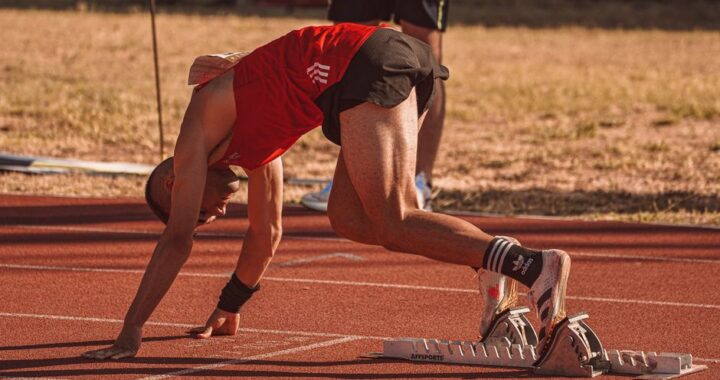
A hamstring strain in sprinters is usually an overload or tear in one of the muscles at the back of the thigh. It often happens during maximum-speed running, acceleration, or a sudden change of pace. The first priorities are to stop sprinting, protect the injured leg, and arrange an assessment if pain is severe, walking is difficult, or bruising develops.
How a hamstring strain happens during sprinting
The hamstrings work hard as the leg swings forward and then prepares to strike the ground. They are placed under particularly high force near the end of the swing phase, when the knee is extending and the hip is flexing. Fatigue, a sudden increase in sprint volume, inadequate recovery, and a previous hamstring injury can increase the risk.
A hamstring pull may affect the biceps femoris, semitendinosus, or semimembranosus muscle. Some injuries involve only a small number of muscle fibres, while more serious tears can affect the tendon or the attachment near the pelvis. The location and severity influence recovery time.
Common symptoms and injury grades
- Mild strain: Tightness or sharp pain during sprinting, with little loss of strength and limited bruising.
- Moderate hamstring tear: Clear pain, reduced stride length, weakness, tenderness, and possible bruising. Walking or jogging may be uncomfortable.
- Severe tear: Sudden intense pain, a popping sensation, marked weakness, swelling, extensive bruising, or difficulty bearing weight. A tendon injury or complete rupture must be considered.
Pain at the back of the thigh is not enough to determine the grade. A sports physiotherapist or doctor can assess strength, movement, tenderness, and the injury mechanism. Ultrasound or magnetic resonance imaging may be useful when the diagnosis is uncertain, the injury is severe, or a return-to-sport decision is difficult.
What to do in the first few days
Stop sprinting and avoid stretching into pain. Use relative rest rather than complete inactivity: gentle walking is reasonable only if it does not increase symptoms or alter your gait. Ice can provide short-term pain relief, and light compression may help with swelling if it is comfortable and does not cause numbness. Elevating the leg can also be useful during the first day or two.
Do not use aggressive massage, hard foam rolling, deep stretching, or fast running immediately after a suspected hamstring injury. These can irritate damaged tissue. Pain medicines should be discussed with a pharmacist or clinician, particularly if there is significant bruising, a history of stomach ulcers, kidney disease, or use of blood-thinning medication.
Rehabilitation for a sprinter’s hamstring injury
Rehabilitation should progress from pain-controlled movement to high-speed running. The exact programme depends on the injury, but a typical progression includes:
- Early loading: Gentle isometric hamstring contractions and comfortable hip and knee movements.
- Strength development: Bridges, hip-extension exercises, controlled split squats, and progressive resistance work.
- Eccentric loading: Exercises such as sliding leg curls, Romanian deadlifts, and later Nordic hamstring exercises, introduced only when basic strength work is comfortable.
- Running progression: Walking, easy jogging, faster running, accelerations, and finally maximal sprinting, with adequate recovery between sessions.
- Event-specific preparation: Starts, curves, relay exchanges, and repeated sprint efforts if they are part of the athlete’s event.
Exercise should not produce a sharp pain or a clear increase in symptoms later that day or the next morning. A useful programme restores strength at longer muscle lengths and builds tolerance to the high-speed demands that caused the hamstring strain in the first place.
When can a sprinter return to training?
Being able to walk or jog without pain does not prove that the hamstring is ready for maximum speed. Before full sprint training, an athlete should generally have normal walking and jogging, near-symmetrical strength, full comfortable movement, and no pain during high-speed drills. The final stages should include progressive accelerations before all-out sprinting.
Return too early is one of the main reasons hamstring injuries recur. The first full-speed session should be controlled, with a reduced number of repetitions and plenty of rest. Training volume can increase only if there is no worsening during the session or within the following 24 hours. A clinician or sports physiotherapist should make the return-to-sport decision after a significant tear or a previous recurrence.
Reducing the risk of another hamstring strain
Prevention is more effective when it matches sprinting demands. Maintain regular posterior-chain strength training, include progressive high-speed running rather than rare maximum-effort sessions, and avoid sudden increases in sprint distance or intensity. A thorough warm-up should include easy running, dynamic mobility, drills, and gradual accelerations.
Nordic hamstring training can reduce hamstring injury risk when introduced gradually and performed consistently, but it should complement rather than replace sprint exposure and broader strength work. Sleep, recovery between hard sessions, adequate food and fluid intake, and sensible scheduling also matter, especially during hot conditions or congested competition periods.
When to seek medical assessment
Seek prompt medical care for severe pain, a popping sensation, major bruising or swelling, a visible deformity, numbness, inability to walk normally, or pain high near the buttock. Assessment is also advisable if symptoms are not improving after several days, if the injury keeps returning, or if a young athlete is involved. Local sports medicine clinics, physiotherapists, and qualified medical practitioners can help establish a safe rehabilitation plan where specialist imaging is available.
A hamstring strain in sprinters should be treated as a performance injury, not simply a tight muscle. Early protection, progressive loading, and a measured return to maximum speed give the athlete a better chance of resuming training without repeating the injury.