The false start rule in athletics determines whether an athlete began a race before the starting signal. Under World Athletics rules, a competitor must remain motionless in the required starting position until the report of the starting gun. A movement judged to have caused the start before the gun can lead to disqualification.
The rule applies at competitions held under World Athletics regulations, including major meetings and many national events across Africa. Local school, club or federation competitions may add administrative procedures, but they generally follow the same basic starting principle.
What counts as a false start?
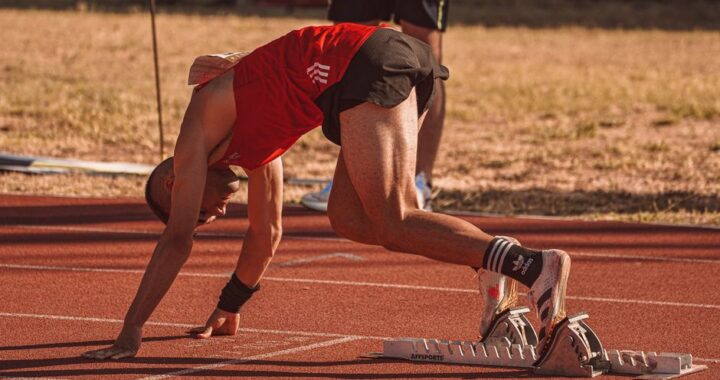
In sprint races using starting blocks, athletes respond to the commands “On your marks” and “Set.” After the “Set” command, each runner must be settled in the required position. Moving out of that position before the gun is fired may be called a false start.
The starter does not need to wait for an athlete to leave the blocks completely. A hand lifting, a shoulder movement or another action that gives the athlete an early advantage can be enough if the officials judge that it caused the start. The decision belongs to the starter and the relevant recall officials, supported by the timing system where one is available.
A competitor may adjust their position after the “On your marks” command, provided the movement does not delay the start or disturb other athletes. Once the “Set” command has been given, unnecessary movement is much more likely to result in the race being recalled.
What is the penalty for a false start?
In most individual races up to and including 400 metres, the athlete responsible for a false start is disqualified immediately. The same principle applies to relay races up to and including 4 × 400 metres, subject to the event format and the applicable competition regulations.
This means the modern rule is not generally a “two false starts and you are out” system for ordinary sprint races. The athlete who causes the early start can be removed from the race after the officials review the incident. A warning may be issued for other starting offences, such as delaying the start, but a warning is not a substitute for the false-start penalty when an athlete has clearly caused the early movement.
Officials can also disqualify an athlete for conduct that deliberately disrupts the start. The precise procedure, including the display of cards or recording of the offence, can vary according to the competition’s technical regulations.
How the reaction-time rule works
At elite meetings, starting blocks are connected to a start information system. The system records the pressure pattern in each block and measures how quickly an athlete reacts after the gun.
A reaction time below 0.100 seconds is treated as evidence of a false start under the World Athletics starting procedure. Human reaction to the sound of the gun normally takes longer than that threshold, so a recorded time below it indicates that the athlete began applying force before the signal reached them or before the permitted response could occur.
The number shown by the system is not the only consideration. Officials examine the complete start, and the starter may decide that a movement was not caused by the athlete. For example, a technical problem or an external disturbance can require the race to be recalled without blaming a competitor.
False starts in longer races and combined events
Races longer than 400 metres usually begin from a standing position. Athletes receive the “On your marks” command, but there is no “Set” command in the normal long-distance start. A competitor must still remain behind the starting line and must not begin moving forward before the gun.
Combined events, such as the decathlon and heptathlon, use a different false-start penalty. In these competitions, athletes are allowed one false start for the race as a whole. Any athlete responsible for a subsequent false start in that race is disqualified. This provision prevents one early movement from unfairly deciding a multi-event competition while still protecting the integrity of the start.
Common questions about the athletics false-start rule
Can an athlete be disqualified without leaving the blocks?
Yes. A movement before the gun can be a false start even if the athlete does not cross the line or fully rise from the blocks. The issue is whether the movement began the starting action or gave an early advantage.
Does a reaction time of exactly 0.100 seconds mean an automatic false start?
No. The automatic threshold concerns a reaction time below 0.100 seconds. Officials still assess the full circumstances of the start and the information supplied by the starting system.
Is the false-start rule the same in every African competition?
World Athletics rules provide the standard used by international and many national competitions in Africa. School, university and community meetings may use modified procedures, so athletes should check the event’s technical briefing before competing.
Can an athlete appeal a false-start disqualification?
Appeal rights depend on the competition’s regulations and the evidence available, such as start-system data and video. A team official normally must follow the stated protest and appeal deadlines. An appeal is more likely to succeed when there is evidence of equipment failure, an external disturbance or an incorrect application of the rule.